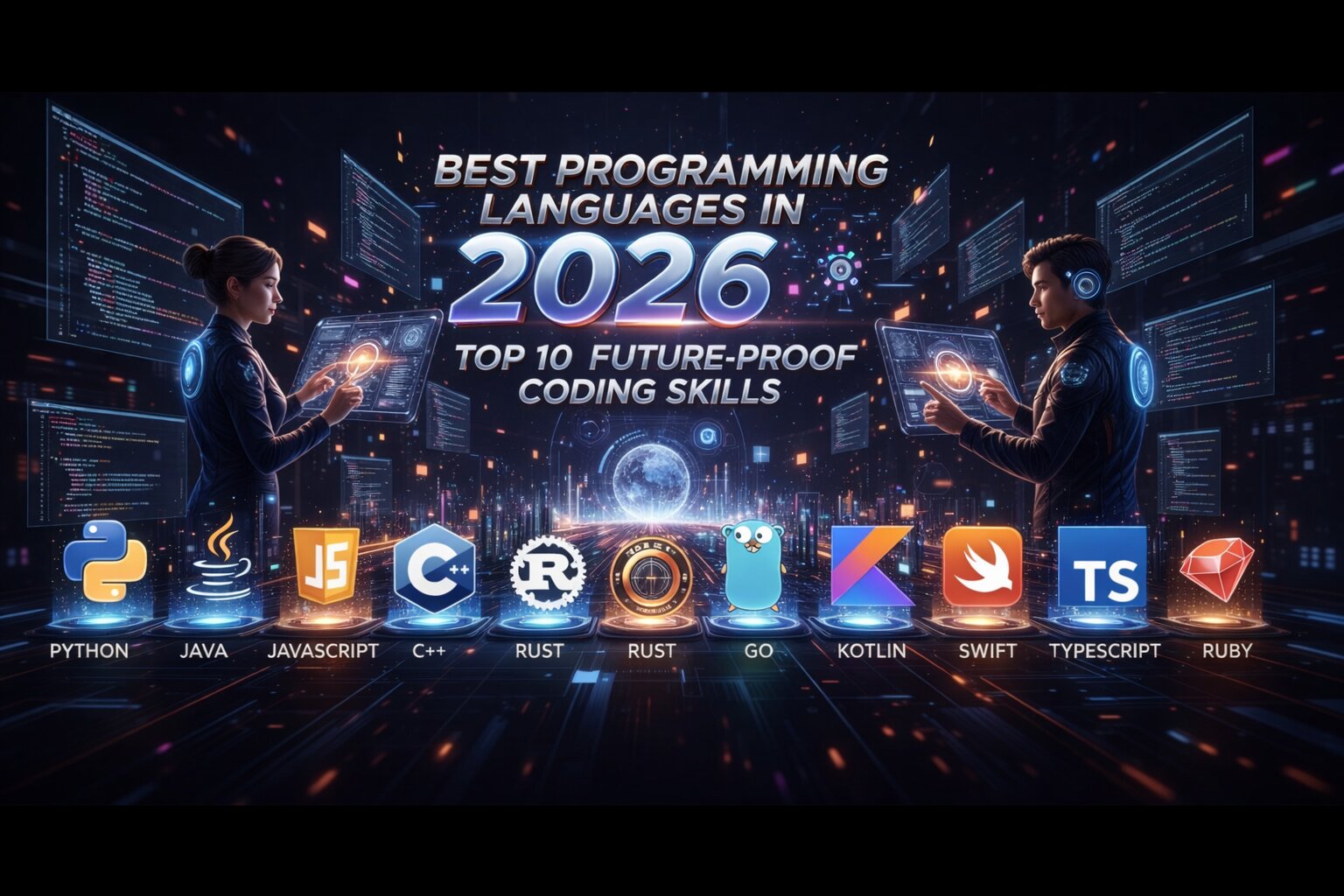
The global technology industry is evolving at an unprecedented pace. New technologies emerge every year, and the demand for skilled developers continues to grow across industries. Artificial Intelligence, cloud computing, cybersecurity, automation, blockchain, and data engineering are transforming how modern software systems are built.
If you are planning your tech career in 2026, choosing the right programming language is not just about learning syntax. It is a strategic decision that can influence your job opportunities, salary potential, and long-term career growth.
Some programming languages dominate emerging industries like AI and cloud infrastructure, while others are essential for enterprise systems, mobile development, and web applications.
Understanding which languages are growing, which industries are adopting them, and how companies are hiring developers will help you make a smarter learning decision.
In this detailed guide, we will explore:
- The most in-demand programming languages in 2026
- Global salary trends for developers
- Which languages offer the highest job demand
- Which languages are best for beginners
- Which programming skills will remain relevant for the next decade
- How to choose the right language based on your career goals
This guide will help beginners, students, and experienced developers make a well-informed decision about which programming language to learn next.
Why Choosing the Right Programming Language Matters in 2026
The programming language you choose determines the type of projects you work on, the industries you can enter, and the salary you can earn. While learning multiple languages is beneficial over time, starting with the right language can significantly accelerate your career growth.
In previous decades, developers often focused on traditional languages like C, C++, or Java. However, the modern technology ecosystem has shifted toward languages that support scalable applications, cloud computing, artificial intelligence, and distributed systems.
Companies today prioritize languages that allow faster development, better scalability, and easier maintenance.
In 2026, the fastest-growing technology sectors include:
- Artificial Intelligence and Machine Learning
- Cloud-native software development
- Cybersecurity and secure infrastructure
- Blockchain and Web3 technologies
- Mobile application development
- DevOps and automation tools
- Data engineering and analytics platforms
Each of these industries relies on specific programming languages optimized for their needs.
For example:
- AI and machine learning rely heavily on Python
- Modern web applications use JavaScript and TypeScript
- Cloud infrastructure tools are often written in Go
- Blockchain platforms rely on Solidity and Rust
- Mobile apps depend on Kotlin and Swift
Learning a language aligned with these high-growth industries ensures:
- Better job opportunities
- Higher salary potential
- More freelance and remote work options
- Long-term career stability
Top 10 Best Programming Languages to Learn in 2026
1. Python – The Leader in AI, Machine Learning, and Automation
Python continues to dominate the programming ecosystem in 2026. It is widely considered the most versatile programming language and is used in a wide range of fields including artificial intelligence, automation, data science, backend development, and scientific computing.
One of the reasons Python is so popular is its simplicity. The language has a clean and readable syntax that makes it easier for beginners to learn while still being powerful enough for enterprise-scale applications.
Major technology companies such as Google, Netflix, Instagram, and Spotify use Python in various parts of their technology stack.
Python is particularly strong in the field of artificial intelligence and machine learning, which are among the fastest-growing industries in the world.
Key areas where Python is used include:
- Artificial Intelligence and Deep Learning
- Machine Learning models
- Data science and analytics
- Automation and scripting
- Web backend development
- Scientific computing
- Cybersecurity tools
Popular Python frameworks and libraries include:
- Django – a powerful web framework
- Flask – lightweight backend development
- TensorFlow – machine learning platform
- PyTorch – deep learning framework
- Pandas – data analysis library
- NumPy – scientific computing
Because of its versatility and massive ecosystem, Python remains one of the best programming languages for beginners as well as experienced developers.
2. JavaScript – The Foundation of the Modern Web
JavaScript remains one of the most essential programming languages in the world. Every modern web browser runs JavaScript, making it the backbone of web development.
Whether you are building a simple website or a large SaaS platform, JavaScript plays a critical role in modern web applications.
JavaScript enables developers to create interactive user interfaces, dynamic web pages, and full-stack applications.
Key areas where JavaScript dominates include:
- Frontend development
- Backend APIs
- Full-stack applications
- Real-time applications
- Single-page applications
Popular frameworks and technologies in the JavaScript ecosystem include:
- React – widely used frontend framework
- Angular – enterprise frontend framework
- Vue.js – lightweight UI framework
- Node.js – backend runtime environment
- Next.js – modern React framework
- Express.js – backend web framework
Because web applications power most modern businesses, JavaScript developers are in high demand worldwide.
3. TypeScript – Scalable JavaScript for Large Applications
TypeScript is a superset of JavaScript that adds static typing and advanced developer tooling. It was developed by Microsoft and has become the preferred language for building large and scalable web applications.
Large codebases often become difficult to maintain when using plain JavaScript. TypeScript solves this problem by introducing types that help developers catch errors during development rather than at runtime.
Benefits of TypeScript include:
- Improved code reliability
- Better developer productivity
- Easier debugging
- Better support for large teams
Many modern frameworks such as Angular, NestJS, and Next.js are heavily optimized for TypeScript.
As web applications grow more complex, TypeScript adoption continues to increase across startups and enterprise companies.
4. Go (Golang) – Cloud Infrastructure and Microservices
Go, also known as Golang, is one of the fastest-growing programming languages for backend systems and cloud infrastructure.
Developed by Google, Go was designed to handle highly scalable distributed systems.
It is widely used in cloud platforms and DevOps tools.
Major technologies built using Go include:
- Docker
- Kubernetes
- Terraform
- Prometheus
Go is particularly strong in:
- High-performance backend services
- Microservices architecture
- Cloud infrastructure tools
- Networking applications
- API development
Because cloud computing continues to expand globally, Go developers are highly sought after in the job market.
5. Rust – Performance and Safety
Rust has become one of the most admired programming languages among developers due to its focus on performance and memory safety.
Unlike many traditional languages, Rust prevents memory errors at compile time, which makes it ideal for systems programming and security-critical applications.
Rust is increasingly used in:
- Blockchain platforms
- Operating systems
- Game engines
- Embedded systems
- High-performance servers
Major companies including Microsoft, Amazon, and Cloudflare are adopting Rust for performance-critical software.
Rust developers often command some of the highest salaries in the software industry.
6. Java – Enterprise Stability
Java remains one of the most widely used programming languages in enterprise environments.
Many large organizations rely on Java to power mission-critical systems such as banking platforms, financial services, and large-scale backend infrastructures.
Java is widely used in:
- Enterprise backend systems
- Android mobile applications
- Financial platforms
- Large distributed systems
Frameworks such as Spring Boot make Java highly powerful for building scalable backend services.
Because many enterprise systems rely on Java, it continues to provide strong job stability.
7. Kotlin – Modern Android Development
Kotlin has become the preferred programming language for Android app development.
Google officially supports Kotlin for Android development, and most modern Android applications are now built using Kotlin instead of Java.
Kotlin offers several advantages:
- Cleaner and more concise syntax
- Improved safety features
- Full compatibility with Java
- Better developer productivity
Mobile applications remain one of the largest software markets in the world, making Kotlin developers highly valuable.
8. Swift – iOS and Apple Ecosystem Development
Swift is the primary programming language used for developing applications in Apple's ecosystem.
Developers use Swift to create applications for:
- iPhone (iOS)
- iPad (iPadOS)
- Mac computers (macOS)
- Apple Watch (watchOS)
- Apple TV (tvOS)
Swift offers modern syntax, strong safety features, and excellent performance.
Because Apple devices dominate the premium smartphone market, Swift developers remain in strong demand.
9. C# – Game Development and Enterprise Applications
C# is widely used for both enterprise software development and game development.
The Unity game engine, one of the most popular game development platforms in the world, uses C# as its primary programming language.
C# is commonly used in:
- Game development
- Enterprise software
- Desktop applications
- Cloud applications using .NET
With the growth of the gaming industry and Microsoft's ecosystem, C# continues to remain highly relevant.
10. Solidity – Smart Contracts and Web3
Solidity is a specialized programming language used to develop smart contracts on blockchain platforms such as Ethereum.
Smart contracts are self-executing programs that run on decentralized networks.
Solidity is widely used for building:
- Decentralized finance (DeFi) platforms
- NFT marketplaces
- Blockchain gaming platforms
- Token systems
Because blockchain technology continues to grow, Solidity developers often receive premium salaries.
Highest Paying Programming Languages in 2026
Some programming languages command higher salaries due to their specialized use cases and limited developer supply.
Based on global industry trends, the highest paying languages include:
- Rust – high-performance systems
- Go – cloud infrastructure
- Solidity – blockchain development
- Python – AI and machine learning
- TypeScript – large web applications
Developers working in AI, cloud computing, and blockchain often receive the highest compensation.
Programming Language Salary Comparison
- Solidity: $130,000+ average
- Rust: $120,000+ average
- Go: $115,000+ average
- Python: $110,000+ average
- JavaScript: $105,000+ average
Actual salaries depend on several factors:
- Experience level
- Country or region
- Company size
- Industry demand
- Specialized skills
How to Choose the Right Programming Language
The best programming language depends on your career goals.
- Artificial Intelligence → Python
- Web Development → JavaScript or TypeScript
- Cloud Infrastructure → Go
- Blockchain → Solidity
- Mobile Apps → Kotlin or Swift
- Game Development → C#
If you are a beginner, start with Python or JavaScript because they provide broad opportunities across multiple industries.
Future Trends in Programming
The future of programming will be influenced by several technological shifts.
- AI-assisted software development
- Serverless computing
- Edge computing platforms
- Quantum computing research
- Low-code development platforms
Developers who combine programming skills with cloud infrastructure, AI, and system design will remain highly valuable.
Conclusion
The best programming languages in 2026 are those aligned with high-growth technology sectors such as artificial intelligence, cloud computing, mobile applications, and blockchain development.
Python and JavaScript remain excellent starting points for beginners because they offer flexibility across multiple industries.
Developers looking for specialized, high-paying roles may consider Rust, Go, or Solidity.
Ultimately, the most important factor is not just the language you choose, but how deeply you understand programming fundamentals, algorithms, system design, and real-world problem solving.
Technology trends will continue to evolve, but strong programming foundations will always remain valuable.
Frequently Asked Questions
Which programming language has the highest salary in 2026?
Solidity and Rust currently offer some of the highest salaries due to demand in blockchain and systems programming.
Is Python still worth learning in 2026?
Yes. Python remains dominant in AI, automation, machine learning, and data science.
Which language is best for beginners?
Python and JavaScript are considered the best programming languages for beginners because of their simplicity and strong community support.
How long does it take to learn a programming language?
Most beginners can learn the basics of a programming language within 3–6 months with consistent practice.